


Enhancing HPLC Field Service with fast-response, non-invasive fl owmeters
Carlo Dessy, Testa Analytical Solutions e.K.
Published in Lab Asia – June 2024

Field Service Engineers are crucial to scientists striving to get the most from their analytical equipment. The maintenance, performance assurance and validation of HPLC/uHPLC systems gains particular importance when this equipment is an essential component in labs subject to compliance found in the pharmaceutical, food, beverage, and environmental analysis sectors.
Precise monitoring, maintenance and troubleshooting play a vital role in ensuring the accuracy and repeatability of data from HPLC/uHPLC systems. Operating for extended periods of time and expected to deliver a stream of solvents not only at a constant rate, but at an exact rate selected by the user, solvent delivery pumps are core to any HPLC/ uHPLC system.
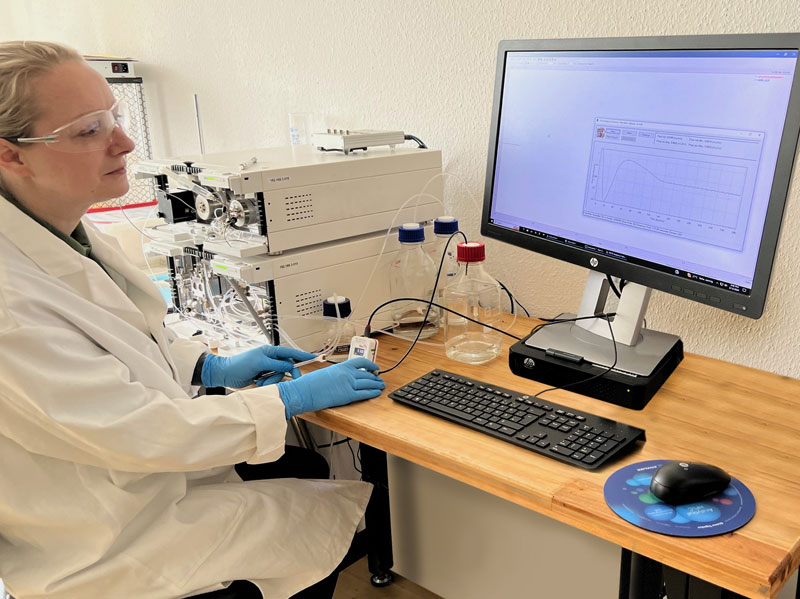
In short, pumps are expected to be fl awlessly precise and accurate over an extended period of time. As such, Field Service Engineers spend a considerable amount of time just to assure this and certify compliance.
Although this seems at first trivial, evaluating the performance of any HPLC/uHPLC pump is a challenging task, as parameters including flow stability, drift, pulsation, and absolute accuracy, should be determined, considered, and evaluated to provide a reliable answer. While absolute accuracy can be determined by time-consuming gravimetric or volumetric methods, stability and pulsation can traditionally only be derived by the stability of the measured pressure. The pressure measured and displayed by a typical pump sensor delivers limited information at a resolution not sufficient to reveal singularities or events of lower amplitude. This makes pressure measurement alone not a reliable strategy for identifying and solving problems related to HPLC/uHPLC pump flow.
The desire of many HPLC/uHPLC service engineers is for a device which supplies the required information with good time resolution and without affecting the HPLC/uHPLC System, thus allowing a direct determination of all parameters relevant to the performance of the pump.
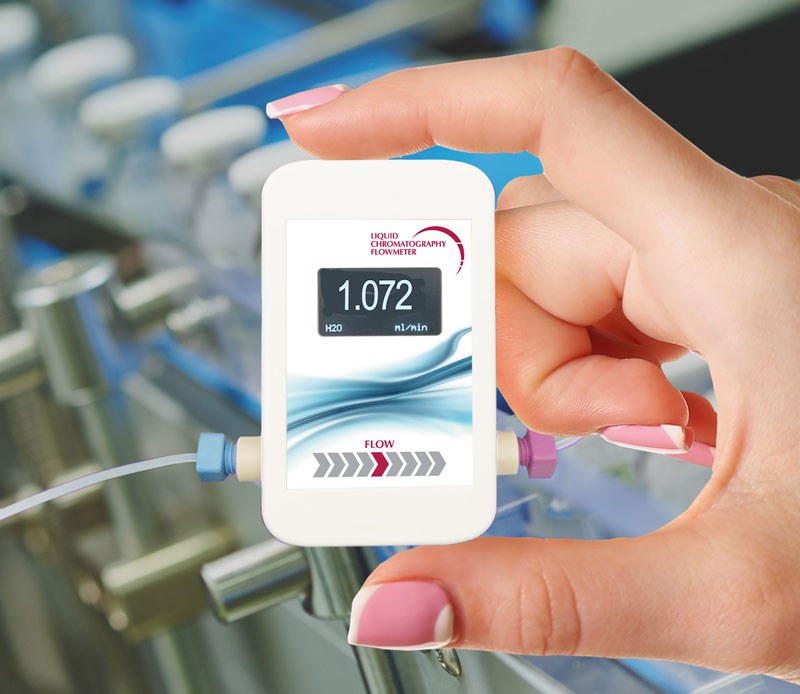
Today, a new generation of non-invasive, real-time flowmeters has been shown to be capable of supplying the required ‘service’ information and fulfilling all aspects of validation of an HPLC/uHPLC pump quickly and accurately.
These flowmeters operate on the basis of a thermal determination of effective flow. They offer high precision and accuracy, combined with excellent resolution. Of significant importance, when troubleshooting, they also offer a fast response allowing Service Engineers to detect very short-time changes in flow rate as found when check-valves or gaskets of a pump are not 100% functional but not yet failing completely.
The term ‘Non-Invasive’ might sound strange in the context of flow measurement as any accurate measurement requires physical contact with solvent. In the context of the described flowmeter and HPLC/uHPLC pump validation, however, the term explains that the tool (the flowmeter) can be connected at the very end of the HPLC/uHPLC system and does not therefore introduce any additional volume or back pressure which might negatively influence the system performance. The flowmeter does not ‘invade’ the system with negative properties and does not disrupt operation.
In fact, such non-invasive flowmeters are being evaluated to become a permanent component of HPLC/uHPLC systems delivering flow data directly to a Chromatography Data System along with all other detectors present, thereby enabling continuous validation of flow.
Use of a non-invasive flowmeter for the tasks performed by an HPLC/uHPLC Service Engineer offers numerous advantages compared to using traditional gravimetric or volumetric test methods. The biggest benefit is that these new generation non-invasive flowmeters reduce needed time for completion of the onsite service job. In addition, these devices offer service engineers the possibility to offer early identifi cation of an underlying problem like a sticking check-valve or a bearing with a micro-leakage. Adding pre-emptive service measures will lead to less equipment downtime and higher HPLC/uHPLC user satisfaction.
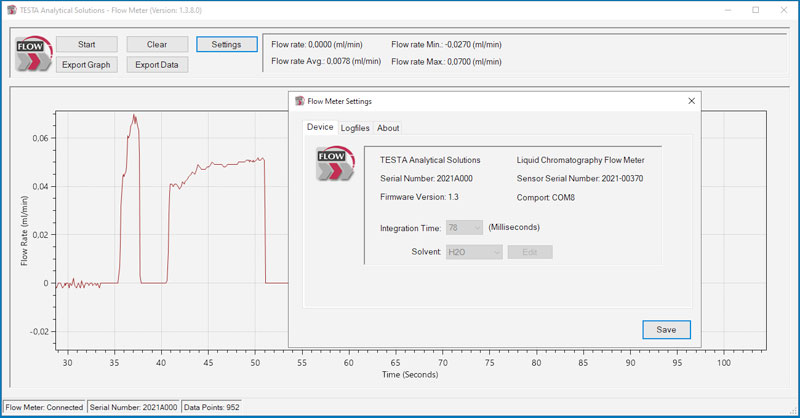
Looking to the future, permanently connecting a non-invasive fl owmeter to an HPLC/uHLPC system, and storing real-time fl ow data along with chromatographic data, offers the potential for a fi eld service engineer to access the full history of pump performance since the last validation.
In conclusion, Field Service Engineers are vital for assuring the quality of performance of all HPLC/uHPLC systems. The best available tool for HPLC / uHPLC pump validation, flow measurement and fl uidic troubleshooting today is undoubtedly a non-invasive realtime liquid flowmeter. For further information please visit: https://www.testa-analytical.com/hplc-chromatography.html.
The author: Carlo Dessy is Managing Director of Testa Analytical Solutions eK, a respected international developer and supplier of instruments, innovative detectors and software for chromatography applications and molecular weight determination. He may be contacted on cdessy@testa-analytical.com.
Thank You!

Your message has been forwarded to our team and we will reply as soon as possible. Thank you for your patience.
© 2026 TESTA Analytical Solutions e.K. All rights reserved.