


EXCLUSIVE: Testa Analytical's monitoring device used to validate preparative HPLC pump
Published in Scientist Live – December 2024

Regular pump flow rate validation is crucial to ensuring pump performance, repeatability, and compliance with regulations. In this investigation, a non-invasive, real time flow monitoring device - the Prep Flowmeter (Fig. 1) was used to validate a Teledyne SSI Ml 40ml single-headed, positive displacement piston pump commonly used for preparative liquid chromatography applications.
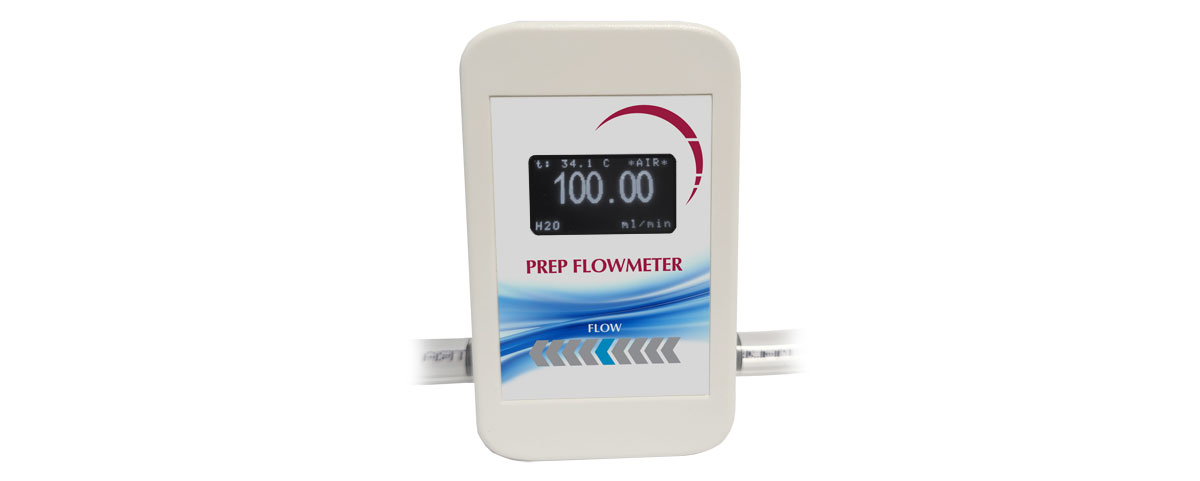
The Prep Flowmeter has an operating range of 1 - 650 ml/min and is based around a thermal flow sensor, where it can be demonstrated that the difference in temperature measured by the devices two sensors is a function of the flow rate. Using a proprietary algorithm this temperature difference is then converted into absolute flow rate units.
To ensure that the flow meter can detect any anomalies that arise from the passage of solvents through your preparative liquid chromatography system, it should be placed at the end of the flow path, after any mixers, check valves, and back pressure regulators. Even though each pump can dispense fluid over a range of flows, the target flow rate for each pump in the application is considered as the central data point on a three-point plot. In this way, the pumps will be validated for the particular range of operation.
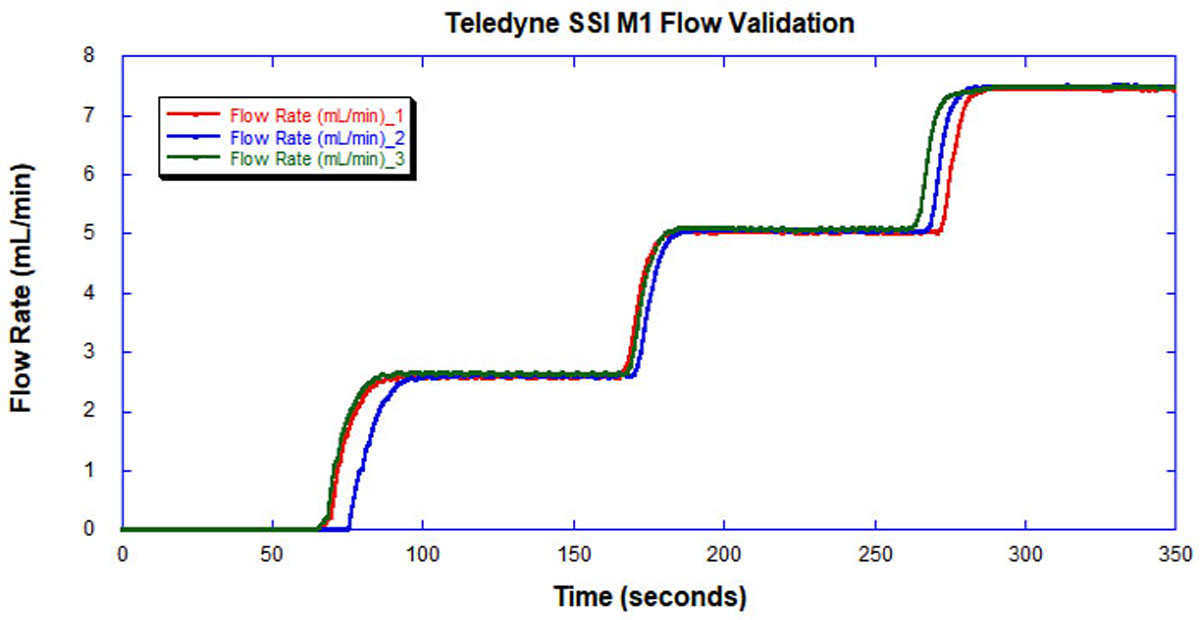
Each flow rate was measured three times for a minimum of one minute to achieve appropriate signal averaging and a statistically significant data set. The flow meter settings were configured to characterize water at a sampling rate of 1170 ms. The data shown in Figure 2 shows the flow rate of the pump measured by the Prep Flowmeter. Each of the individual data sets were overlaid on the same time scale to display strong reproducibility.
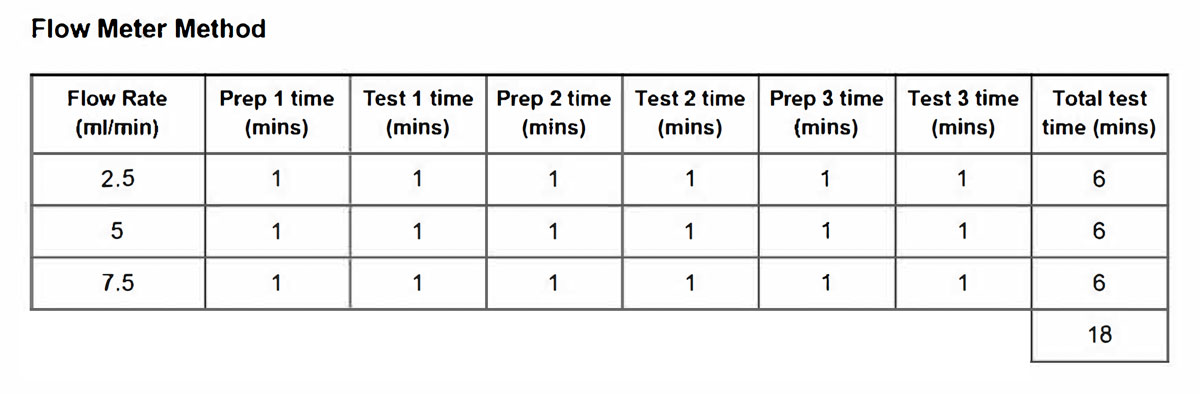
Through experimentation we found just nine minutes of data must be collected to conduct each pump validation with the Prep Flowmeter. Overall, a total of just 18 minutes was required to perform a full flow measurement and pump validation experiment.
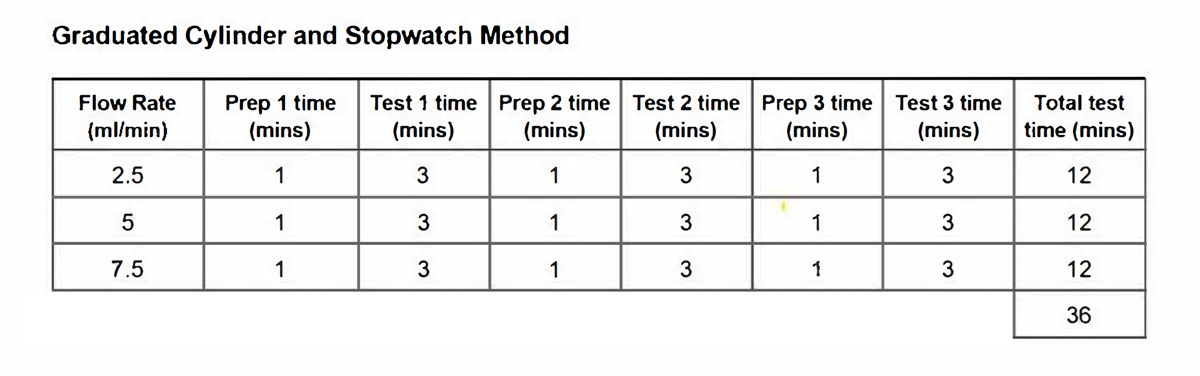
On the other hand, the time required to conduct the same procedure employing the traditional preparative chromatography calibration method (see table 2 below) that uses a graduated cylinder and stopwatch is much longer. As it is impractical to measure a volume of fluid in a graduated cylinder for one minute, a rule of thumb is to measure three times the volume for the flow rate in question e.g., 15 ml of fluid should be measured for a flow rate of 5 ml/min. This modest approach automatically doubles the time necessary to conduct a full experiment to at least 36 minutes. This also does not account for human error in visually monitoring the graduated cylinder or for the reaction time to trigger the start and stop of each measurement on the stopwatch. Another major concern that impacts volume measurement is the handling and evaporation of organic solutions.
Conclusion
Overall, using a Testa Analytical Prep Flowmeter has been shown to significantly reduce the amount of time necessary to conduct a pump validation test for a preparative liquid chromatography system. At the same time, using the real time digital data from a Prep Flowmeter eliminates human error and allows for pump validation of non-aqueous systems. Moreover, the visualization and continuous data collection allow the user to quickly interpret the accuracy of pump flow, stability, and consistency while providing a simple means to produce graphical plots, and analysis tables for certification and client reports.
Note: TESTA Analytical extends thanks to its US colleague - Mike Drenski for undertaking this experimental work.
Thank You!

Your message has been forwarded to our team and we will reply as soon as possible. Thank you for your patience.
© 2026 TESTA Analytical Solutions e.K. All rights reserved.