


Validating HPLC results obtained using any solvent

High-Performance Liquid Chromatography (HPLC) stands as a cornerstone technique in analytical chemistry, facilitating the separation, identification, and quantification of chemical and biological compounds. While many applications are based upon aqueous eluents, HPLC separation protocols also often involve the utilization of other solvents to accommodate the unique properties of different analytes. Ensuring consistent elution profiles is a key requirement to ensure reproducible results. Continuous monitoring of the delivered HPLC eluent flow rate is therefore essential when permanent validation of results is desired or necessary as it is in regulated industries.
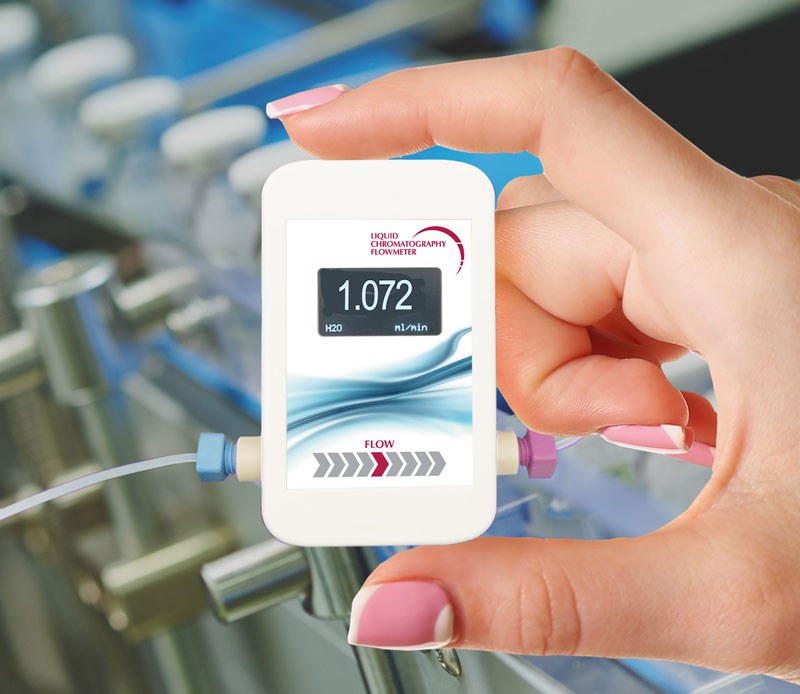
TESTA Analytical’s range of non-invasive liquid flowmeters (see Figure 1) are designed and proven to deliver accurate flow rate data in real-time thus fulfilling the requirements for continuous monitoring.
However, like any flow measurement device, these flowmeters require a solvent-specific calibration in order to provide absolute flow rate data. Therefore, an experimental study was undertaken to explore how the original response from a non-invasive HPLC flowmeter, is affected by the utilized solvent.
Proof of validity of performance of the TESTA Analytical HPLC flowmeter, was tested by measuring the apparent flow rate obtained with different solvents, using the device calibrated in pure water. Our assumption for this experiment was, that if the device is capable of performing as required with different solvents, the reported apparent flow rates for each solvent should follow a linear function. This is a common requirement for acceptable HPLC calibrations. The apparent flow rate of nine different solvents commonly used in HPLC applications, were measured at 4 different flow rates for several minutes each. The results obtained are plotted in Figure 2 below.
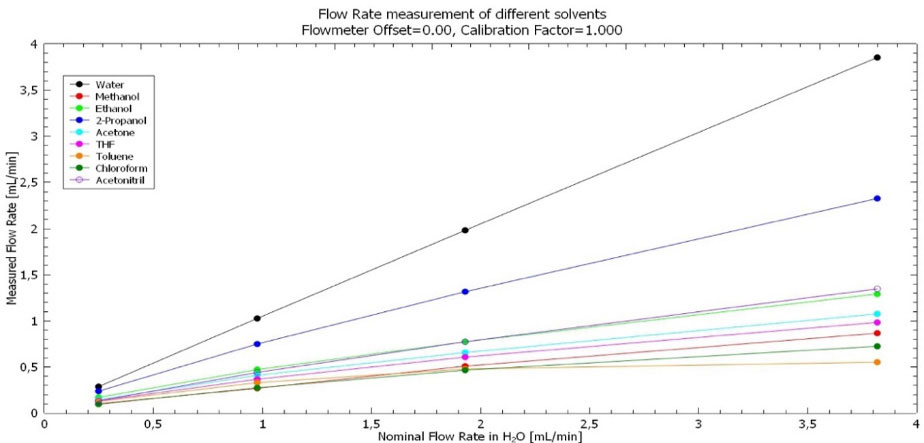
From this experimental data it is apparent that the response function for each solvent follows a well-defined response function. This confirms the capability of the HPLC flowmeter to be used to accurately measuring flow rates independent of the eluent solvent.
Conclusion
This experiment shows how TESTA Analytical HPLC flowmeters can be used to accurately monitor flow rates of a wide range of solvents in real-time. This capability demonstrates that the HPLC flowmeter is a valuable tool for determination of solvent specific calibration factors which allow scientists to generate absolutely correct flow rate data for almost any HPLC application.
The versatility of the TESTA Analytical flowmeter represents a major advance in assuring the validity of HPLC results obtained with any solvent. Industries reliant on dispensing systems, such as pharmaceutical manufacturing, may also leverage this unique capability.
Recent development, now allows seamless software integration of flow data from TESTA Analytical HPLC flowmeters with Chromatography Data Systems (CDS), facilitating inclusion of validation data with each chromatogram.
Thank You!

Your message has been forwarded to our team and we will reply as soon as possible. Thank you for your patience.
© 2026 TESTA Analytical Solutions e.K. All rights reserved.