


Conformity or Calibration - which certification do you require for your Flowmeter?

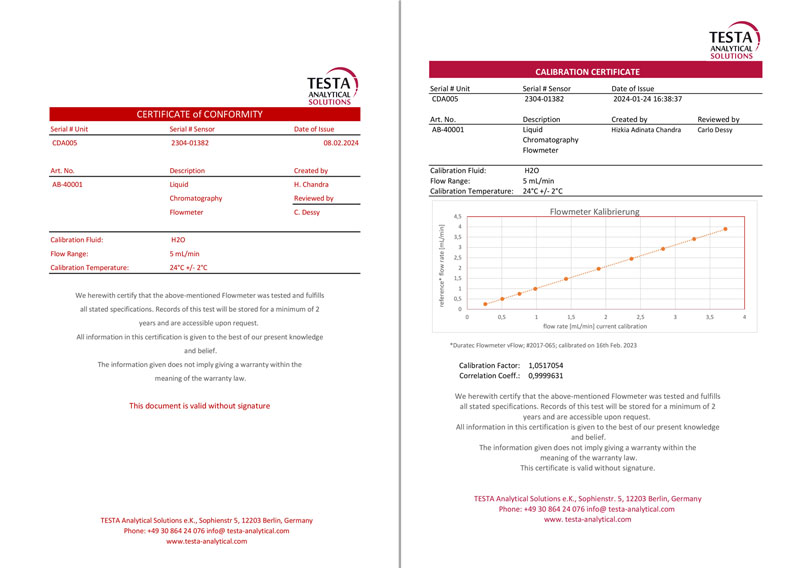
All TESTA Analytical Flowmeters come with a Certificate of Conformity which demonstrates compliance of each individual product with our published specifications.
The certificate of conformity testifies the internal process involved in assuring a certain quality of each and every flowmeter shipped to clients. This process includes fulfillment of a documented production process to a set of measurements aimed to prove that each and every instrument delivered will perform within specification.
This certification is usually sufficient for all applications involving constant monitoring of flow rate. It is, however, not sufficient in applications which aim to validate or certify the performance of a pump within its range of operation.
Such applications require the use of Flowmeters which are themselves validated. In short, a traceable calibration is required for all the Flowmeters which are to be used in validation applications.
A traceable calibration is a calibration process that ensures the measurements taken by an instrument or device can be traced back to a known standard or reference that is directly or indirectly linked to a national or international standard. In other words, it means that the calibration procedure follows a documented chain of comparisons to established standards, which leads back to a recognized reference standard, such as those maintained by national metrology institutes.
Key components of traceable calibration include:
1. Documented Procedures: There are clear, documented procedures for calibrating the instrument or device, ensuring consistency and repeatability.
2. Reference Standards: The calibration process involves comparing measurements against reference standards that have a known and documented level of accuracy.
3. Chain of Comparisons: There is a documented chain of comparisons that connects the reference standards used in the calibration process to higher-level standards, leading back to national or international standards.
4. Documentation and Records: Calibration certificates or reports provide documentation of the calibration process, including details of the standards used, the procedures followed, and the results obtained. These records enable traceability by allowing others to verify the calibration process.
As an additional service - Testa Analytical can offer traceable calibrations for its range of Flowmeters. This enables us to produce for you a Certificate of Calibration which certifies that we have undertaken a 10-point calibration routine covering the full range of operation for each supplied Flowmeter.
All records relating to each, and every calibration are stored at Testa Analytical for a minimum of 10 years, assuring total transparency in case of doubt or questions.
In regulated environments especially, traceable calibrations often require re-validation on an annual basis. Traceable calibration provides increased confidence in your obtained results and therefore in any validation based upon these results.
While both TESTA Analytical certificates serve to instill confidence in the reliability and quality of a supplied flowmeter, they differ in their focus and scope.
A Certificate of Conformity confirms compliance with broader requirements or standards.
By comparison, a Certificate of Calibration verifies the accuracy and traceability of an individual supplied Flowmeter.
Both certificates play vital roles in quality assurance and are essential for maintaining consistent and reliable flow rate measurement.
Thank You!

Your message has been forwarded to our team and we will reply as soon as possible. Thank you for your patience.
© 2026 TESTA Analytical Solutions e.K. All rights reserved.