


Real-Time Monitoring of HPLC Pump Performance

Introduction
High Performance Liquid Chromatography (HPLC) is nowadays one of the most widely used techniques in analytical chemistry. The range of applications soluble using HPLC covers a vast range of sample types, concentrations, and compositions. This extreme flexibility is achieved by using specific columns carefully designed for each particular investigation. However, all HPLC separations have one detail in common: they are reliant on a stable and constant flow rate of solvent and by this they all require constant performance of the HPLC pump. This technical note describes how a novel method of continuous monitoring of flow rate can provide real-time validation of the total HPLC system performance and as such, improve reliability of results.
Traditional Methods
Up to now, direct determination of flow rate has been limited to system validation using volumetric flowmeters, or, when monitoring was required, by use of Coriolis force flowmeters.
While Volumetric flowmeters are known to be accurate, the method they use is relatively slow as measurement requires that a known volume must be filled and time difference must be detected in order to obtain a single data value. As such, volumetric flowmeters integrate over a relatively large volume (often several hundred microlitres) and are not suitable for delivering “real time” flow information.
Coriolis Force flowmeter are well proven for providing very accurate flow measurement in HPLC systems but unfortunately are quite expensive, therefore again a limited solution.
A New Technological Approach
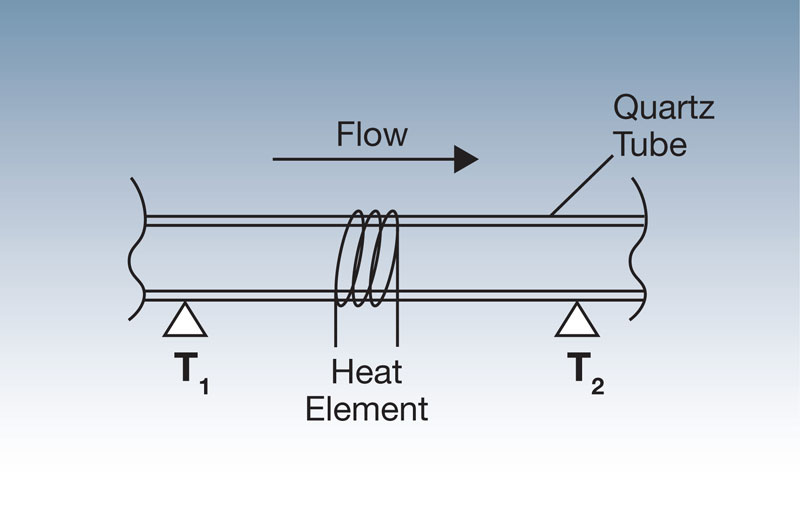
Introduced in 2020, the TESTA Analytical Solutions Liquid Chromatography Flowmeter is based around a thermal Flow Sensor (Fig. 1).
In the Liquid Chromatography Flowmeter – the solvent flows through a quartz tube. Temperature sensors (T1 & T2) are positioned before and after a heating element which elevates the solvent temperature slightly. It can be demonstrated that the difference in temperature measured by the two sensors is function of the flow rate in the quartz tube. Using a proprietary algorithm this temperature difference is then converted into absolute flow rate units. Not only is this flow measurement technique extremely accurate and sensitive – but it also offers the advantage of being non-invasive i.e. flow is not interrupted in any way. Consequently, using this flow measurement method, the TESTA Analytical Solutions Chromatography Flowmeter has the potential to be an ideal tool for monitoring of solvent flow rates in HPLC Systems as it does not interfere with the measurement itself.
Pump Monitoring Deasibility Study
Feasibility of continuous monitoring of a relatively simple HPLC System, consisting of isocratic pump, sample injector and differential refractive index (DRI) detector was carried out using a TESTA Analytical Solutions Liquid Chromatography Flowmeter. No column was used to enable the experiment to focus strictly on HPLC pump performance and avoid any flow variation due to the column (such as column bleeding). Pure deionized water was used as the solvent for the experiment, flow rate was set to a nominal 1.000 mL/min. The Chromatography Flowmeter was connected to the outlet of the DRI Detector and the outlet of the flowmeter was then led to a waste bottle. Data acquisition of Flow Rate values was realized using TESTA’s Flow App via the Flowmeter USB Port, which also provides power supply to the device, and the PC. Data rate was approximately 15 Hz or 15 values per second. The pump flow was then started along with data acquisition. The experiment was run for several days, day and night, with daily replenishment with fresh deionized water.
Results
The complete flow stability data collected over several days is far too large to be displayed in this technical note, we therefore picked a representative 6000 seconds segment (see Fig. 2) to illustrate typical data output using the Chromatography flowmeter to monitor an HPLC pump.
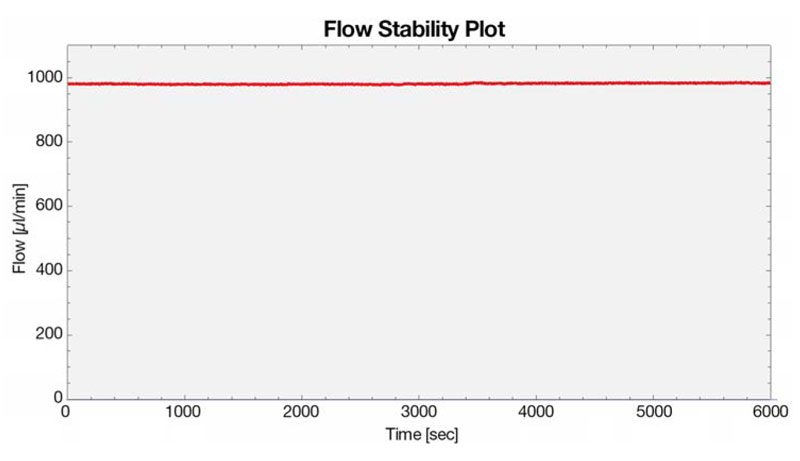
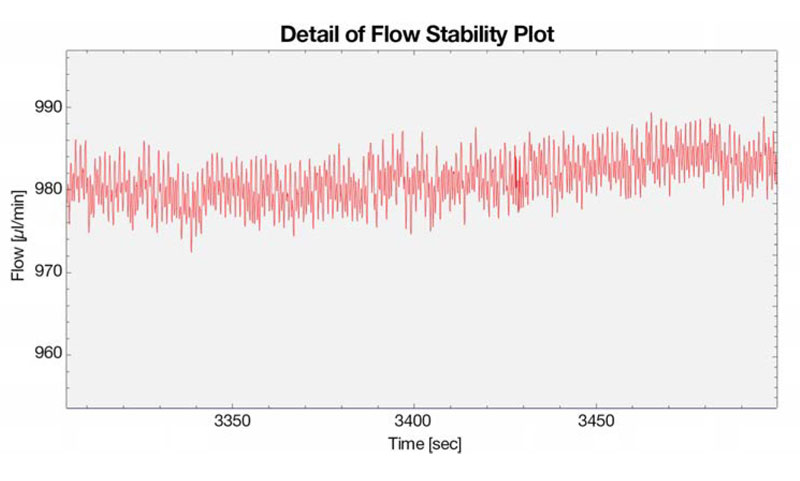
The above Figure 2 plot shows the flow rate to be close to the nominal 1.000 mL/min and appearing to be very stable over time. However, if this data is studied in high-resolution (see Fig 3 below) we can clearly see term variation of flow from the HPLC system.
Conclusions
This experiment clearly demonstrates the ability of the TESTA Analytical Solutions Liquid Chromatography Flowmeter in combination with the Flow App to collect in real-time flow data from an HPLC pump and therefore determine total HPLC system performance.
The high-resolution, real-time flow data that can be obtained using a Liquid Chromatography Flowmeter opens the gate to deeper analysis of HPLC Pump performance parameters such as pulsation thereby allowing a stricter definition of required parameters for reliable HPLC separation results. Furthermore, this technology offers a completely new tool for troubleshooting of HPLC Systems. This will be object of future investigations.
Thank You!

Your message has been forwarded to our team and we will reply as soon as possible. Thank you for your patience.
© 2026 TESTA Analytical Solutions e.K. All rights reserved.